
The electric hedge trimmer represents the vast majority of sales for individuals, but the choice of a suitable model depends on parameters that product sheets rarely summarize. Since October 2023, the French regulatory framework on neighborhood noise has tightened, and several departments are restricting the time slots for using gardening tools. The noise level is no longer just a comfort criterion: it is a legal constraint.
Neighborhood noise and electric hedge trimmers: what the regulations have changed since 2023
Decree No. 2023-924 of October 5, 2023, has reclassified offenses related to neighborhood noise as 4th class fines. Specifically, a noise characterized by its duration, repetition, or intensity exposes the user to a fixed fine of 135 euros, and up to 750 euros in case of recidivism or a proven disturbance observed in court.
This provision applies to all gardening tools, including hedge trimmers, even during the day. It is no longer sufficient to respect the authorized hours to be compliant: the duration and intensity of the noise also count.
Since June 2025, about 23 departments in the South and Southwest have added a ban on the use of noisy gardening equipment between 12 PM and 4 PM during the summer period. Var, Gard, Hérault, Gironde, Charente, and Aveyron are part of this list.
For homeowners in these areas, a wired or battery-powered electric hedge trimmer, whose noise level remains well below that of a thermal model, offers wider working windows. The comparisons available on taille-haie-electrique.com allow filtering models based on this criterion, which makes practical sense in these departments.
Tooth spacing and cutting diameter: the underestimated technical criterion
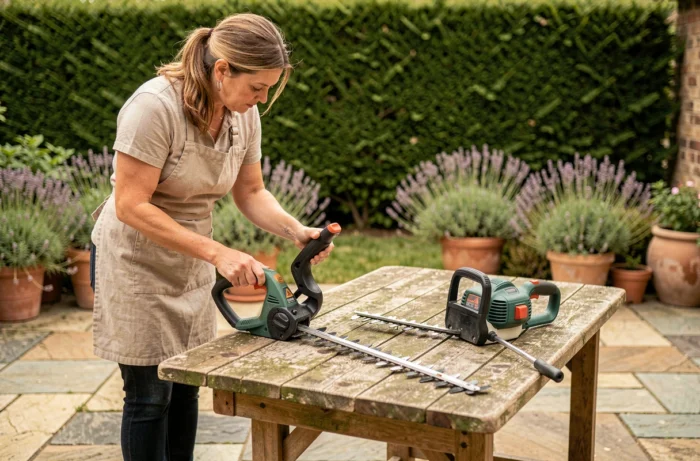
The motor power and blade length are the two characteristics highlighted by manufacturers. However, the spacing of the blade teeth, which determines the maximum diameter of branches that the hedge trimmer can cleanly cut, is often relegated to the bottom of the technical sheet.
A reduced spacing is suitable for young evergreen hedges (privet, laurel) whose branches remain thin. For a mature hornbeam or beech hedge, whose branches regularly exceed one centimeter in diameter, a wider spacing is necessary. Forcing a hedge trimmer on branches that are too thick for its teeth damages the blade and the motor, resulting in a ragged cut that weakens the plant.
How to assess the match between the tool and your hedge
Before any purchase, measure the diameter of the thickest branches of your hedge at the point where you usually trim. Compare this measurement to the tooth spacing announced by the manufacturer. The rule: the spacing must be greater than the diameter of the common branches.
- Young or regularly trimmed hedge (thin branches): a modest spacing is sufficient, and a lightweight model will make the work faster.
- Old, dense hedge with woody branches: prefer a wide spacing and a motor capable of maintaining cutting speed under load.
- Mixed hedge (evergreens and deciduous mixed): field reports vary on this point, as the diameter of branches varies significantly from species to species. It’s better to base it on the toughest species present in the hedge.
Actual weight and muscle fatigue: trimming for an hour or trimming for ten minutes
A hedge trimmer is held at arm’s length, often above shoulder level to reach the top of the hedge. The difference between a model weighing three kilos and one approaching five kilos seems trivial on paper. In practice, after twenty minutes of trimming at height, this difference becomes a fatigue factor that degrades cutting precision and increases the risk of injury.
The weight announced by the manufacturer does not always include the battery. For cordless models, always check the “tool equipped” weight with the battery mounted. Some manufacturers display the bare weight, which skews the comparison with a wired model.
Balance and mass distribution
A well-balanced hedge trimmer naturally holds horizontally without straining the wrist. Two devices of identical weight can offer radically different comfort depending on the position of the motor and battery. The distribution of mass is as important as the total weight for prolonged use.
Wired or battery: decide based on the garden configuration
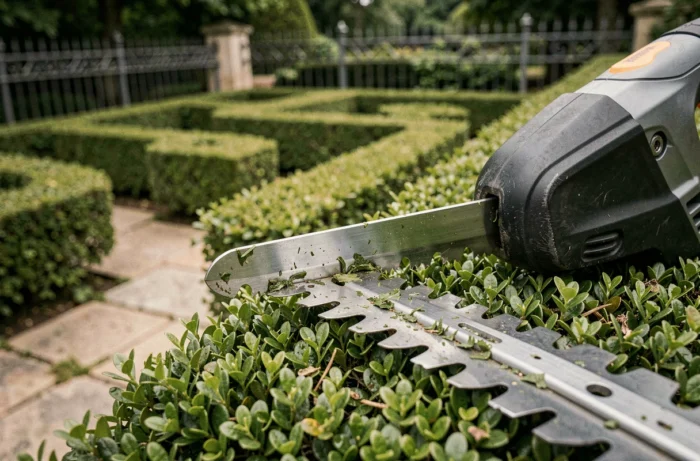
The choice between a wired hedge trimmer and a battery model often boils down to a trade-off between autonomy and power. This perspective is incomplete.
A wired model requires managing a cable, which complicates work on long hedges or those far from the house. The risk of cutting the cable with the blade exists and generates domestic accidents every year. However, a wired model does not experience any drop in performance during use: the power remains constant from start to finish.
A battery model offers total freedom of movement, but the actual autonomy depends on the thickness of the branches being trimmed. On soft, thin wood, the battery lasts its advertised duration. On dense branches, consumption increases significantly and effective working time decreases.
- Compact garden with an electrical outlet close to the hedge: the wired model remains the simplest and least expensive choice.
- Large garden or hedge at the property line far away: the battery eliminates the constraint of the cable and the need for an extension cord.
- Several hedges to trim in the same session: plan for a second battery or check the recharge time before purchase.
Trimming period and biodiversity protection
The French Office for Biodiversity encourages individuals to avoid trimming hedges from March 15 to July 31, the nesting period for birds. This recommendation does not constitute a legal prohibition for individuals (it is for farmers in certain contexts), but it conditions the timing of your hedge trimmer’s use.
In practice, the two main trimming windows are at the end of winter (February-March) and at the end of summer (August-September). An electric hedge trimmer stored for eight months a year deserves blade maintenance before each resumption: a dull blade strains the motor and produces uneven cuts that expose the plant to diseases.
The choice of the right electric hedge trimmer depends less on the brand or price than on three concrete parameters: the tooth spacing relative to your hedge, the actual weight of the equipped tool, and the noise level in an increasingly stringent regulatory context. Measuring your branches before comparing technical sheets remains the most useful gesture, and the least often advised.