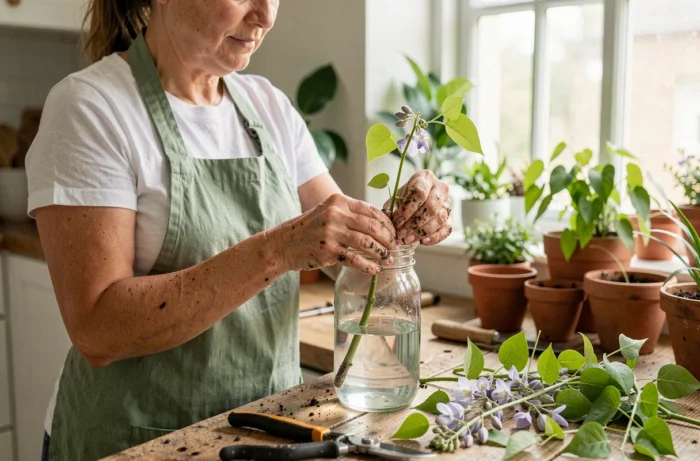
Wisteria (glycine) can be propagated by placing a stem cutting in a container of water until adventitious roots appear. This method, simpler than substrate propagation, imposes a specific constraint: aquatic roots are structurally different from terrestrial roots, being more fragile and less branched. The transfer to soil must occur early to avoid failure during repotting.
The node of the stem, a critical point for water propagation of Wisteria
Every attempt at propagation relies on a precise anatomical point: the node of the stem. It is at this swelling, located at the junction between the stem and the base of a leaf, that the cells capable of producing roots are concentrated.
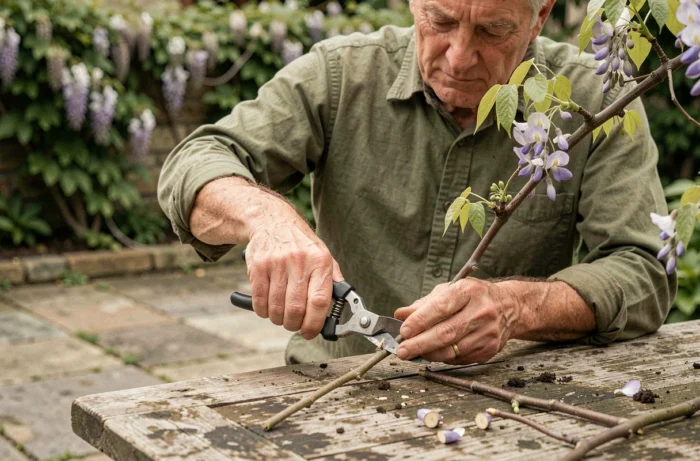
A section of Wisteria without a node has very little chance of producing roots, even if kept in water for several weeks. The cut should therefore be made just below a node, a few millimeters away. The upper part of the cutting should retain at least one or two upper nodes with their leaves, which nourish the stem through photosynthesis during rooting.
Before placing the cutting in water, the leaves located on the lower half must be removed. A submerged node with an attached leaf will rot, and this decomposition quickly contaminates the container. To successfully propagate Wisteria in water easily, this cleaning of the base remains the most decisive step.
Choosing a semi-lignified stem: the type of wood that roots in water
Wisteria produces three types of wood throughout the year: the green shoots of spring (very soft), the semi-lignified stems of late summer (soft but in the process of lignification), and the hardwood of winter (rigid, brown). Only semi-lignified stems are suitable for water propagation.
A green spring stem absorbs water, softens, and rots before producing any roots. The winter hardwood, too lignified, takes a considerable amount of time to react in a simple glass of water, as its cells are already specialized and less reactive.
The semi-lignified stem is recognized by its green-brown color and moderate flexibility: it bends without breaking but resists when bent. Late summer, between August and September, corresponds to the window when this type of wood is abundantly available on the plant, often after summer pruning.
Conducting propagation in water: container, light, and water changes
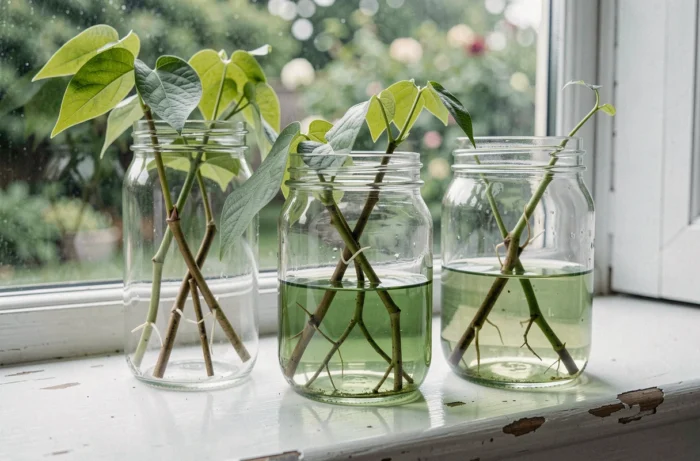
The ideal container is a clear glass pot. Transparency allows monitoring the appearance of roots without handling the cutting and detecting any potential greenishness of the water (a sign of algae or bacteria proliferation).
Some concrete points to respect:
- The water should be changed every three to four days. Stagnant water promotes bacterial growth that attacks the base of the stem before it has rooted.
- The water level should cover the lower node but should not exceed half of the cutting. Excessive immersion deprives the stem of oxygen over too much surface area.
- The cutting should be placed in indirect light, not in direct sunlight. A north or east-facing windowsill is suitable. Direct sunlight heats the water and accelerates degradation.
Rooting hormone is not necessary in water, but it can speed up the process. If you use it, apply it to the dry base of the stem before immersion, in powder form rather than gel (the gel dissolves immediately in water and loses its localized effect).
Transfer to substrate: the moment when most cuttings fail
Roots formed in water are adapted to an aquatic environment. They are white, thin, and lack developed root hairs. A late transfer dooms the cutting: roots several centimeters long, accustomed to water, do not survive the abrupt contact with draining potting soil.
The right time for transfer is as soon as the roots measure a few centimeters. At this stage, they are short enough to adapt to a new environment without excessive water stress.
The receiving substrate should remain very moist during the first week, almost soaked, to facilitate a transition between the aquatic and terrestrial environments. A mix of sand and potting soil ensures sufficient drainage while retaining moisture. Gradually reduce watering over the following weeks to encourage the cutting to develop functional terrestrial roots.
Wisteria from cuttings: realistic timeline before flowering
According to the Royal Horticultural Society, a Wisteria from seed can take up to twenty years to flower. Propagation shortens this timeline, as the cutting retains the genetic maturity of the mother plant. A named Wisteria, multiplied by cutting or layering, generally flowers much earlier than a plant from seed.
This point deserves attention: if the mother plant is itself an unselected seedling, the cutting will inherit the same uncertain characteristics. It is better to take from a plant with proven and regular flowering.
Air layering: an alternative when water propagation fails
Some Wisterias resist propagation, even under suitable conditions. Air layering offers superior reliability because the future plant remains nourished by the mother plant throughout the rooting phase.
The technique involves burying a lower portion of the stem still attached to the plant or wrapping an aerial segment in moist moss held by plastic wrap. The separation occurs only once the root ball is well formed, usually after a complete season.
Water propagation remains the most accessible method for anyone with a simple glass and clean pruning shears. Success depends on three factors: a cut below the node, a semi-lignified stem, and a transfer to soil as soon as the first roots appear. Air layering takes over when the Wisteria refuses to cooperate.