Choosing accommodation during a round-the-world trip is not just about finding a bed for the night. Accommodation accounts for about a third of the total budget for a long journey, and the cost differences between options can vary by a factor of ten depending on the destination and type of establishment. Comparing these options based on measurable criteria allows for decisions that impact the entire duration of the trip.
Average cost per night by type of accommodation on a round-the-world trip
The accommodation category weighs heavily, but not in the same way depending on the chosen option. The table below summarizes the main categories and their financial and practical characteristics, as reported by long-term travelers.
| Type of accommodation | Cost range | Comfort | Social interaction | Booking flexibility |
|---|---|---|---|---|
| Hostel (dormitory) | Very low (sometimes less than €5 in Southeast Asia) | Basic | High | Strong (abundant availability) |
| Guest house / backpacker hotel | Low to moderate | Variable, private room possible | Medium | Strong |
| Short-term rental (Airbnb, etc.) | Moderate to high | Good (kitchen, space) | Low | Medium (check-in sometimes required) |
| Couchsurfing / free accommodation | Free | Unpredictable | Very high | Low (depends on host availability) |
| House sitting | Free (annual subscription to the site) | Good to very good | Low | Low (one-off assignments) |
What stands out from this grid is that cost and social interaction evolve inversely to comfort. Free options offer a rare local immersion but require heavier organization and a less flexible schedule.
To explore the available variants in each region of the globe, the section accommodation on Tour du Monde details the specifics by geographical area.
Reservation fraud: a selection criterion in its own right
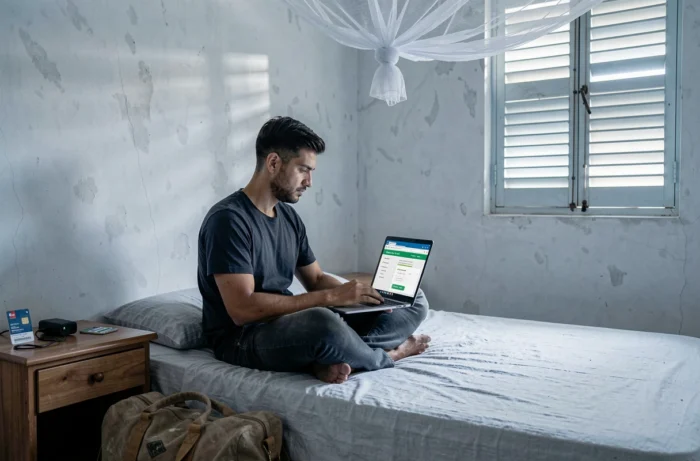
Competitors rarely address this topic, even though it directly affects the reliability of the chosen accommodation. According to an article by Sorenir updated on October 2, 2026, and based on recommendations from Cybermalveillance.gouv.fr, scams follow a recurring pattern: the interlocutor tries to get the traveler off the platform, requests a copy of an ID via private messaging, or proposes payment via bank transfer, cash order, or external link.
On a round-the-world trip, the multiplication of reservations mechanically increases exposure to this risk. Here are the warning signs to watch for before confirming a reservation:
- The host offers to finalize payment outside the platform, via bank transfer or unsecured third-party service.
- The displayed price is significantly lower than the local market for an equivalent property, without visible justification (official promotion, documented low season).
- The listing has no verifiable reviews or was published very recently with generic photos.
- The host requests personal documents (passport, credit card) before any confirmed reservation on the platform.
Booking and paying in full through the official platform space remains the most effective protective measure. This simple reflex eliminates the majority of fraudulent scenarios.
Registration number and local regulation of short-term rentals
The European regulation 2024/1028 now governs the collection and sharing of data related to short-term rentals. In cities or countries that have established a registration system, platforms must display a registration number and conduct validity checks.
For a traveler on a round-the-world trip, this development has a practical consequence: the absence of a registration number on a listing in a European city constitutes a non-compliance signal. By booking accommodation without this number, one exposes oneself to potentially illegal lodging, with a risk of last-minute cancellation if local authorities intervene.
Check compliance outside of Europe
Outside the European Union, regulations vary significantly. Some popular destinations for round-the-world travelers (Thailand, Colombia, Mexico) do not impose a centralized registration system for short-term rentals. In these cases, reading recent reviews and checking the age of the listing remain the most reliable indicators.
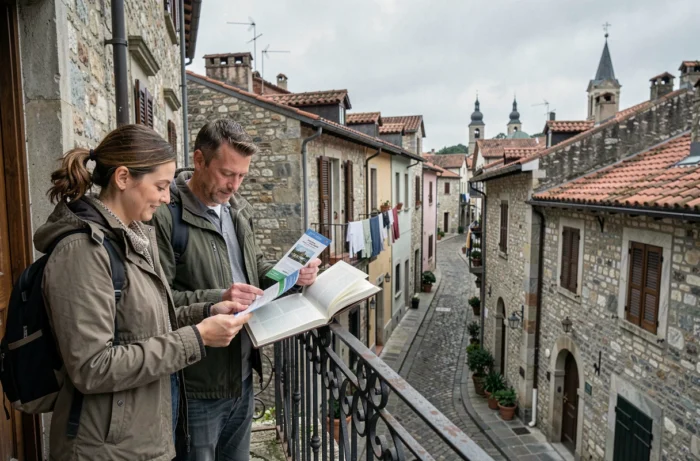
Balancing budget and length of stay by destination
The choice of accommodation is not made just once at the start. It is recalibrated at each stage of the journey, depending on the local cost of living and the planned duration on site.
In Southeast Asia, where backpacker hotels offer private rooms for a few euros, opting for a dormitory in a hostel only brings marginal savings. In contrast, in countries where accommodation weighs more (Australia, New Zealand, Japan), hostels or house sitting become significant budget levers.
The other variable often underestimated is duration. A short-term rental becomes financially interesting from several consecutive nights in the same city, thanks to the decreasing rates offered by most platforms. For stays of one or two nights, guest houses and hostels remain more suitable: no exit cleaning, no key handover, no deposit.
Mixing options according to stages
Long-term travelers who best manage their budget do not choose a single type of accommodation for the entire trip. They alternate based on the context:
- Hostel in major tourist cities where the supply is dense and prices competitive.
- Guest house or small local hotel in rural or less connected areas, where digital platforms poorly cover the actual supply.
- Short-term rental for long stays (a week or more) in the same city, especially to have access to a kitchen.
- Couchsurfing or house sitting as occasional options to reduce the budget in expensive destinations.
Eurostat recorded 951.6 million overnight stays booked through major platforms (Airbnb, Booking, Expedia) in the European Union in 2025, representing an increase of 11.4% compared to 2024. This growth reflects an ever-wider supply, but also a strengthening of local regulations. Checking regulatory conditions before booking is no longer an optional precaution; it is a reflex that protects both the budget and the peace of the stay.