
A priority neighborhood of the city policy (QPV) is a perimeter defined by the State based on the income of residents. In Nantes, several areas carry this classification, which conditions both the public measures mobilized and the socio-economic profile of the rental stock. For an investor, understanding this zoning helps distinguish a structural risk from a temporary difficulty undergoing requalification.
Before signing a preliminary agreement, cross-referencing the property’s location with the QPV map and the recorded crime data from SSMSI provides a more reliable reading than online reviews alone. Here are the criteria and sectors to examine closely.
QPV Classification in Nantes: What the Official Map Changes for a Purchase
The geography of QPV has been updated as of January 1, 2024, by the National Agency for the Cohesion of Territories (ANCT). This revision, based on declared incomes, redraws the boundaries of neighborhoods targeted by the city policy until 2030. Specifically, an area that was included in previous perimeters may be removed, and vice versa.
For investors, the direct consequence is twofold. A property located in a maintained or expanded QPV benefits from urban renovation programs (City Contracts, Neighborhood Commitments 2030), which may mean roadworks, residential development, or rehabilitation of social housing in the medium term.
This context can create a potential for revaluation over a horizon of five to ten years, but it also involves enduring a transition period where rental vacancies and tenant turnover remain higher than elsewhere.
Consulting the neighborhoods to avoid in Nantes according to Monde Immobilier allows for cross-referencing this official reading with more recent field feedback.
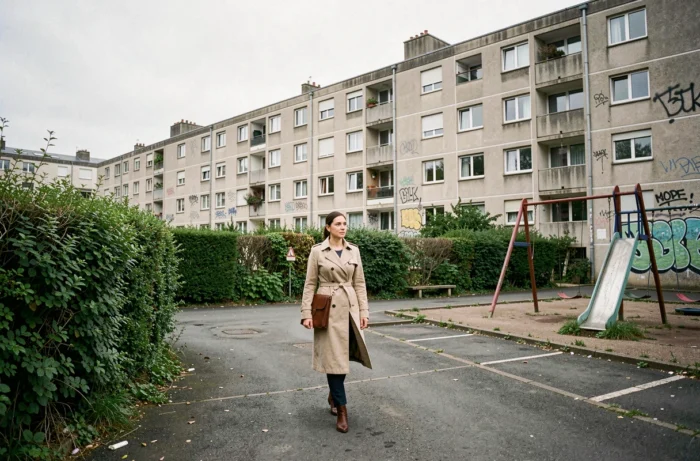
QPV Sectors of Nantes: Malakoff, Bellevue, Dervallières, and Breil
Four names consistently appear in public data: Malakoff, Bellevue, Dervallières-Zola, and Breil. All stem from large housing complexes built in the 1960s-1970s, which concentrate a significant portion of Nantes’ social housing. The QPV classification is maintained there after the 2024 update.
Malakoff: Rehabilitation Underway, but a Long Timeline
Malakoff is undergoing a rehabilitation program covering more than 200 housing units. This project gradually improves the buildings, but the urban renovation works span several years, with construction nuisances and sometimes difficult cohabitation between renovated housing and buildings awaiting renovation. Purchasing in this perimeter implies accepting a potentially higher gross rental yield than in the city center, in exchange for a risk of vacancy and slower resale.
Bellevue and Dervallières-Zola: Transport Flows and Nighttime Vigilance
Bellevue and Dervallières-Zola share a similar profile: decent access by tram or bus, local shops present, but incidents related to trafficking regularly reported in the recorded crime data. Vigilance is particularly focused on evening and nighttime hours. For rental investment, tenant turnover is more frequent there than in the residential neighborhoods of western Nantes.
Breil: An Enclosed Sector Despite Proximity to the Center
Breil is located just minutes from the city center, but its dead-end urban planning and low mix of housing types limit its attractiveness to stable tenants. Urban enclosure weighs more heavily on valuation than perceived insecurity alone.
Nantes North and Bottière: Different Profiles Not to Be Confused
Beyond the four previous sectors, Nantes North (Bout des Pavés, Chêne des Anglais) and Bottière appear in reports. Their situation deserves a distinct reading.
Nantes North combines a dense social housing stock with a relative distance from employment centers in the city center and the island of Nantes. Public transport is available, but the daily commute extends travel time, reducing rental attractiveness for young professionals and students.
Bottière, and more specifically the Zéphyr sector, has benefited from recent renovation programs. New buildings coexist with older buildings still marked by social difficulties. Micro-localization at the street level radically changes the risk profile: a property located on the renovated Zéphyr side and another just a few hundred meters away in the older stock do not present the same potential.

Field Visit Method Before Investing in Nantes
Statistical data and QPV classification provide a framework, but they do not replace an on-site verification. Several reflexes can help limit unpleasant surprises:
- Visit the property and its surroundings at least three different times (weekday morning, weekday evening, weekend). The atmosphere of a neighborhood changes radically between 10 AM and 10 PM, and a single daytime visit may mask nighttime nuisances.
- Check the actual presence of open local shops, not just their location on a map. Closed shutters during the day indicate a fragile economic fabric.
- Consult the recorded crime data from SSMSI, available in open data, to objectify the perception. These statistics detail the types of offenses (thefts, assaults, trafficking) by municipality and sector.
- Ask the property manager or syndic about the vacancy rate of the building and the average lease duration. A high turnover over the past three years is a more reliable indicator than a single neighbor’s opinion.
This method applies to all sectors, including those reputed to be calm. A residential neighborhood like Nantes Erdre or Chantenay-Sainte-Anne can also present occasional flaws (construction nuisances, noisy infrastructure projects) that only a field visit reveals.
The Nantes real estate market remains dynamic, and a sector classified as QPV today is not doomed to the same status tomorrow. The 2024 update of the perimeters, coupled with ongoing renovation programs in Malakoff or Bottière, shows that the reading grid is evolving. A serene investment relies less on a fixed list of neighborhoods to avoid than on the ability to cross-reference public data, multi-time visits, and building analysis, street by street.