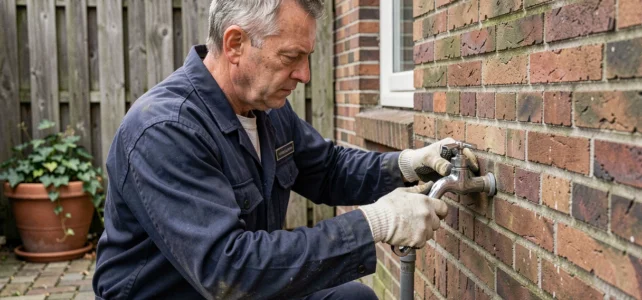
An outdoor faucet connected to the drinking water network is a fully-fledged sanitary installation, subject to the same technical requirements as indoor water points. In Brussels, its installation also involves urban planning rules related to the façade and water management, two aspects often overlooked by DIY enthusiasts.
Exemption or urban planning permit: the façade determines everything
The Brussels-Capital Region considers the visual impact on the façade to decide whether a modification requires an urban planning permit or is exempt. A faucet fixed to the front façade, with visible piping or projection, alters the architectural appearance visible from the roadway. This type of intervention is rarely exempt from a permit.
On the rear façade or on a side wall not visible from public space, the situation is more flexible. Small installations may be exempt from a permit provided they are not located less than twenty meters from a protected property, do not affect the stability of the wall, and comply with the allowed relief limits. Therefore, before drilling, it is essential to precisely identify which wall the faucet will be installed on and check the heritage status of the neighborhood.
When considering to install an outdoor faucet in Brussels, the first step is to consult the urban planning service of the municipality to confirm whether a simple declaration is sufficient or if a permit application is required. Skipping this verification exposes one to an urban planning violation, even for such a modest installation.
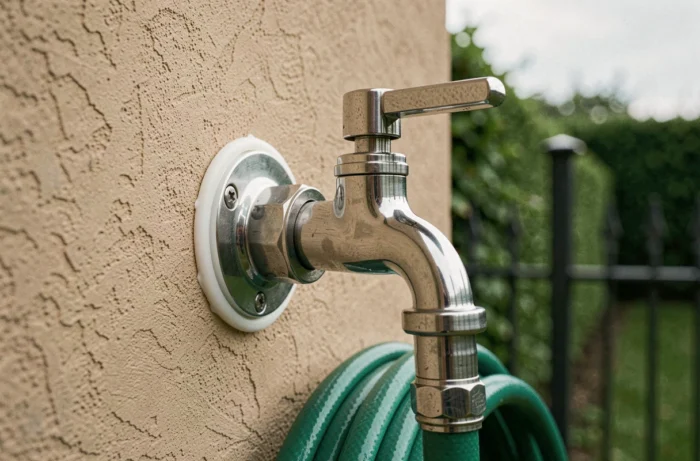
Backflow prevention: technical requirement for any outdoor faucet in Brussels
A garden faucet connected directly to the public network creates a risk of backflow of contaminated water. When a hose is submerged in a puddle, basin, or treatment tank, a drop in pressure in the network can draw this water back into the collective distribution. The technical requirements of Belgaqua impose specific protective devices to prevent this phenomenon.
For an outdoor faucet, the level of required protection depends on the downstream use. A simple watering with a flexible hose requires at least a reduced pressure zone disconnect or an EA-type anti-pollution valve. If the faucet supplies an underground irrigation system with a risk of contact with fertilizers or pesticides, the level of protection increases.
The water installation inspection checks these devices. In Brussels, unlike Wallonia where the CertIBEau has been mandatory since 2021, there is still no formal equivalent. The inspection occurs during the connection or at the request of the distributor, but non-compliance with Belgaqua’s requirements holds the owner responsible in case of contamination.
Connection to a rainwater tank: rules for separating networks
Many Brussels homeowners wish to supply their outdoor faucet from a rainwater harvesting tank rather than from the drinking water network. This choice reduces municipal water consumption but requires a complete physical separation between the two circuits.
The technical requirements prohibit any connection, even indirect, between a rainwater network and the drinking water network. In practice, this means:
- The circuit supplied by the tank must have its own pipes, with no junction points with drinking water pipes, even via a valve
- Faucets connected to rainwater must have clear signage (“non-potable water”) to avoid any confusion
- If a municipal water supply is planned to fill the tank during dry periods, it must pass through a break in pressure (free overflow, no direct connection)
In the Brussels region, the environmental permit also regulates rainwater management during works that modify soil impermeability. If the installation of the tank accompanies a courtyard or terrace development, a “rainwater management” component may be required in the permit application.
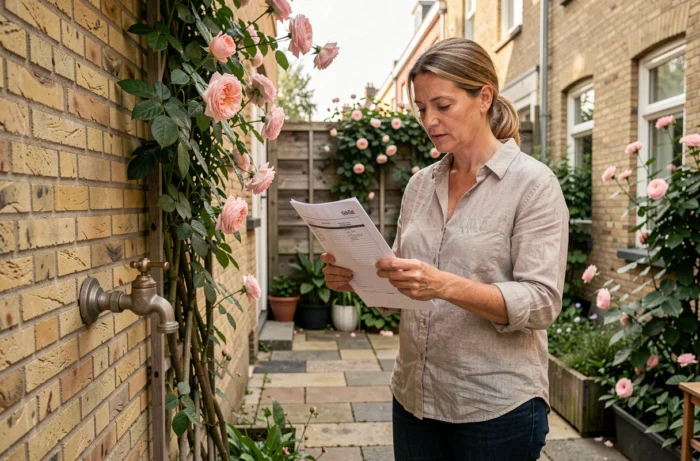
Frost-proof faucet and choice of materials: adapting the installation to the Brussels climate
Brussels winters alternate between nighttime frost and daytime thaws, a cycle that stresses connections much more than constant cold. A frost-proof long-stem faucet places the shut-off mechanism inside the wall, in the frost-free zone. The remaining water in the outer part drains by gravity after each closure, preventing ice formation in the faucet body.
For the piping between the internal network and the faucet, two materials dominate:
- Copper, durable and corrosion-resistant, suitable for wall penetrations. It requires clean soldering or olive fittings
- PERT (cross-linked polyethylene), easier to install thanks to crimp fittings, but sensitive to UV if exposed outdoors without protective sheathing
- Multilayer, a compromise between rigidity and ease of installation, usable in protected outdoor areas but must be insulated against frost
The pipe diameter must match that of the existing internal network to maintain sufficient flow. Undersizing causes a noticeable drop in pressure as soon as another water point is opened in the house.
Drilling the wall without compromising insulation
The wall penetration is the thermal weak point of the installation. The hole must be drilled with a slight slope towards the outside to avoid water infiltration from runoff. A PVC sleeve sealed with waterproof mortar protects the pipe and limits thermal bridging. If the building has external insulation, the penetration must be treated with a compressible seal compatible with the existing insulation.
Sealing is verified by pressurizing the circuit before closing the wall finishes. A leak detected after work requires reopening the wall, a cost and inconvenience that can be avoided by a quick test.
The choice of location, compliance with the backflow prevention device, and adherence to Brussels urban planning regulations determine the longevity of the installation. A well-installed and compliant outdoor faucet then only requires an autumn purge and an annual visual inspection of the connections.