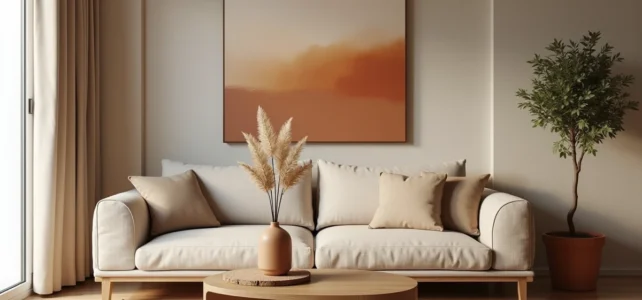
Modern interior decoration is no longer just about choosing a sofa and a wall color. It relies on a combination of materials, volumes, and pieces that tell something personal. Understanding the mechanisms behind a successful interior allows for sustainable choices, far from fleeting fashion trends.
Texture and storytelling: the decor shift of 2025
The all-white minimalism, long considered the benchmark of modern design, is losing ground. The current trend favors textured interiors rich in history, where each surface provides a distinct tactile sensation.
Velvet is gradually replacing rough fabrics on seating. Brown woods, long neglected in favor of bleached oak, are making a comeback in living spaces. Antique pieces (dressers, mirrors, vintage lighting) blend with contemporary furniture to create a deliberate contrast.
This movement has an informal name: casualism. The idea is to compose a space that is intentionally imperfect, alive, and embraces wear and mix. A slightly patinated solid wood tabletop on lacquered metal legs creates a visual tension that gives character to a dining room.
To explore the possible associations between styles and materials, the sheets available on the Wiki for Home website detail numerous combinations suitable for each room in the house.
The return of Art Deco style in contemporary interiors illustrates this dynamic well: marked geometric shapes, dark lacquers, bold patterns. The goal is not to recreate a 1920s living room but to borrow strong elements to visually structure a modern space.

Colors and materials: building a coherent palette room by room
Personalizing an interior starts with the color palette, but not just any way. An effective palette relies on three levels: a dominant shade (walls, large furniture), a secondary shade (textiles, small furniture), and an accent shade (decorative objects, cushions, lighting).
This rule of three avoids two common pitfalls: the boring monochrome interior and the overload of colors that tires the eye. In a kitchen, for example, a natural wood countertop (dominant) combined with sage green facades (secondary) and brass handles (accent) creates a readable and warm ensemble.
Combining warm and cool materials
The mix of materials adds depth to a space. Wood, linen, and wool warm up a room, while metal, glass, and polished concrete bring visual rigor. The balance between the two determines the overall atmosphere.
- In a living room, a boucle fabric sofa placed on a polished concrete floor creates an immediate tactile contrast between comfort and minerality.
- In a bedroom, a black metal bed frame paired with washed linen bedding softens the structure without masking it.
- In a bathroom, tadelakt (Moroccan lime plaster) combined with brushed brass fixtures offers an alternative to standard tiling while remaining functional.
The trap to avoid: accumulating too many different materials in the same space. Beyond three or four distinct materials per room, the visual reading becomes confusing.
Wall decoration without renovations: concrete techniques
Personalizing a wall remains the most accessible decor lever. Several techniques require neither a drill nor heavy intervention, making them compatible with rentals.
Adhesive rails allow you to hang frames and illustrations without drilling. Their load capacity varies by model, but recent versions can support pieces weighing several kilos. They can be removed without damaging the paint, which changes the game for renters.
Repositionable panoramic wallpaper is another option. Applied to a single wall (the accent wall), it transforms the perception of an entire room. Botanical or architectural patterns work particularly well in modestly sized spaces, as they create an illusion of depth.
Creating a readable gallery wall
A successful gallery wall follows an invisible grid. Two approaches work:
- The strict grid: frames of the same size, spaced regularly. Suitable for hallways and narrow rooms, it structures the gaze.
- The organic hanging: frames of varying sizes organized around an imaginary central axis. More relaxed, it suits spacious living rooms and lounges.
- In both cases, placing the frames on the floor before fixing them allows you to test the arrangement. The bottom edge of the lowest frame should ideally be at eye level when sitting, not standing.
Decorative lighting: prioritizing light sources
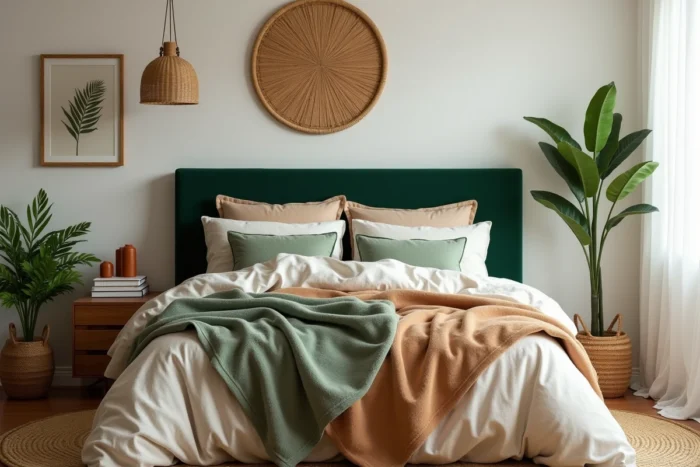
Lighting is often an underestimated personalization lever. A single central ceiling fixture produces flat light that flattens volumes. Multiplying light sources at different heights adds dimension to any room.
At a low level, table lamps and LED strips integrated under furniture create a cozy atmosphere. At an intermediate level, wall sconces sculpt the walls by casting shadows. At a high level, a designer pendant or a directional rail provides functional lighting.
The color temperature matters as much as the intensity. For a living room or bedroom, warm light (around 2,700 kelvins) promotes relaxation. In a kitchen or workspace, a more neutral light enhances visual comfort without causing fatigue.
A modern and personalized interior is not decreed by a bulk order on a furniture website. It is built in successive layers: the structure of materials, the color palette, wall elements, and then the lighting that reveals the whole. Each decision made at one level conditions the next, which explains why the most accomplished interiors are rarely the ones that cost the most, but those where each choice responds to the previous one.