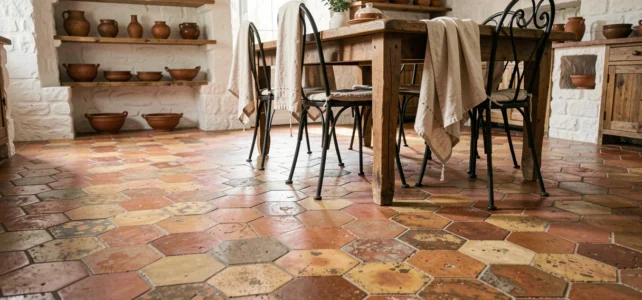
The vintage-style tile mimics the appearance of artisanal terracotta on a porcelain stoneware base. This material offers the durability and ease of maintenance of an industrial tile while replicating the surface irregularities, color variations, and patina characteristic of Provençal tiles. The final result, once laid, depends on factors that cannot be controlled by color alone.
Format and layout: what anchors the credibility of a modern tile
The hexagonal shape remains the format most associated with traditional tiles. It immediately evokes the ancient floors of southern France. Choosing a hexagon over a square or rectangle strongly influences the perception of the floor.
A small hexagon (with a side of less than fifteen centimeters) recalls more of the original artisanal productions. Larger formats, often offered to speed up installation, give a more contemporary look that strays from the old spirit.
The layout, meaning the plan for laying the tiles, plays a direct role in perceived authenticity. A staggered installation with slight offsets imitates the work of a period installer. A perfectly aligned installation betrays the industrial character of the tile, even if its surface is convincing.
Before finalizing a format, check its compatibility with the geometry of the room. A hexagon requires complex cuts at the edges, especially in narrow hallways or bathrooms with multiple angles. Planning these cuts in advance avoids unpleasant surprises on installation day.
A well-chosen vintage-style tile combines a coherent format with the era being imitated, a careful layout, and an irregular surface that naturally captures light.
Grout color and final appearance: the most underestimated parameter
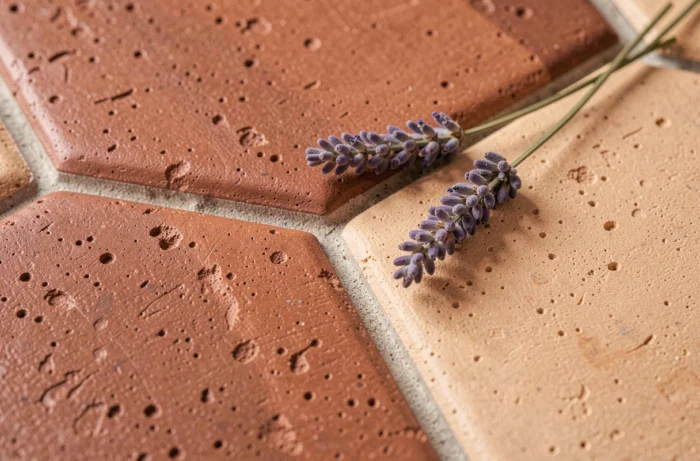
The color of the tile attracts all the attention in the store. On the installed floor, it is often the grout that determines whether the overall appearance seems old or new.
A tone-on-tone grout erases the edges of the tile and creates a continuous surface, resembling a naturally aged terracotta floor. A contrasting grout (white or light gray on a reddish-brown tile) visually separates each piece and produces a more modern graphic effect.
Test the grout before purchase
Several manufacturers and tilers recommend laying a sample with the intended grout before ordering the entire batch. This step takes little time and avoids costly regrets. The visual difference between a sienna-colored grout and a pearl gray grout on the same tile can radically transform the ambiance of a room.
The width of the grout also matters. A narrow grout (two to three millimeters) suggests a contemporary installation. A wider grout recalls older installations, where irregular tiles required a more generous tolerance space.
Natural light and color choice: why the showroom lies
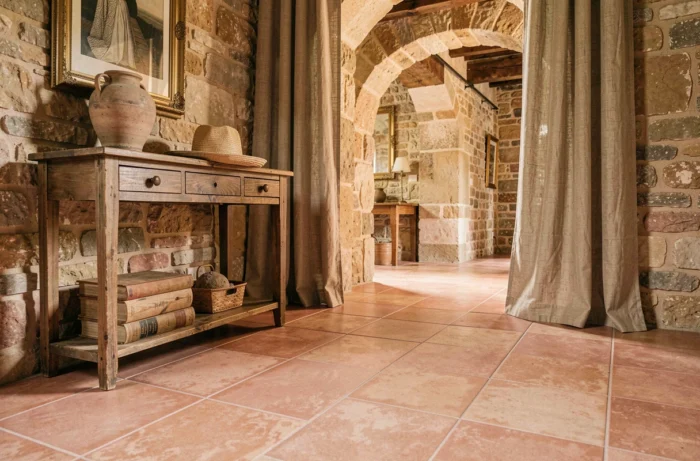
A tile viewed under artificial store lighting does not resemble the same tile laid in a north-facing kitchen. The color temperature of the light alters the perception of the warm tones of the tile.
A tile that appears warm and rosy in the showroom can turn a saturated orange under direct southern light in summer. Conversely, in a dimly lit room, the same tile may seem dull, almost grayish.
- Request one or two samples to lay on the floor in the relevant room, not on a piece of furniture or against a wall.
- Observe the tile in the morning, midday, and evening under artificial lighting to assess the variations.
- Compare the sample with the fixed elements of the room (kitchen furniture, woodwork, countertop) that will not change after installation.
This verification in real conditions is the most reliable way to ensure that the chosen shade will remain credible in daily life.
Vintage-style tile in wet areas: technical criteria to check
The desire to install a vintage-style tile in a bathroom or kitchen faces technical constraints that decorative appearance alone cannot resolve.
Slip resistance and rating
The slip resistance rating (often noted R9, R10, R11) indicates resistance to slipping with shoes on. For a bathroom, a minimum R10 rating is recommended. Some smooth-surfaced vintage-style tiles, designed for living areas, are not suitable for rooms where the floor is regularly wet.
Quality of the substrate
A porcelain stoneware floor laid on an unstable or poorly prepared substrate will crack at the joints, even if the tile itself is water-resistant. Before installation in a wet area, ensure that the substrate is flat, dry, and compatible with a waterproofing membrane (such as SPEC or membrane). The substrate conditions durability as much as the tile.
Compatibility with underfloor heating is another point to confirm. Porcelain stoneware conducts heat well, but the thickness of the tile and the type of adhesive influence the heating time. A thick tile on unsuitable adhesive significantly reduces system efficiency.
Porcelain stoneware or genuine terracotta: decide based on use
Porcelain stoneware that mimics vintage tiles and authentic terracotta are maintained differently. Terracotta is porous, stain-sensitive, and requires regular water-repellent treatment. Porcelain stoneware only requires regular cleaning.
- In the kitchen, where grease splashes are common, porcelain stoneware simplifies maintenance.
- In a living room or entryway with low traffic, authentic terracotta offers a patina that evolves over time.
- In the bathroom, porcelain stoneware wins due to its moisture resistance without surface treatment.
The choice between the two depends on the acceptable level of maintenance, not just aesthetics. A well-chosen porcelain stoneware replicates the old appearance without imposing the constraints of a porous material.
The credibility of a vintage-style floor rarely hinges on the tile alone. Format, grout width, room lighting, technical substrate: each of these parameters can tip the result toward authenticity or blatant imitation. Testing in real conditions remains the most effective precaution before placing an order.