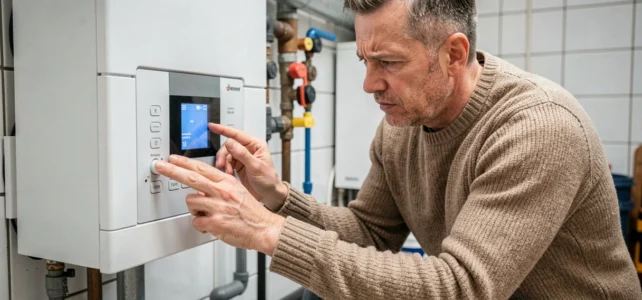
Your boiler is new, the technician has validated the commissioning, and yet some parts remain cold. The problem almost never comes from the boiler itself. It lies in what connects the device to your radiators: the circuit, the settings, and sometimes the building itself.
Heating curve and water law: the adjustment that no one checks
Have you noticed that your boiler seems to operate in fits and starts, never reaching a stable temperature? The cause often lies in a parameter called heating curve (or water law).
This setting tells the boiler what water temperature to send into the circuit based on the outside temperature. A recent condensing boiler is designed to finely modulate its power. If the curve is poorly set, it sends water that is too hot or not hot enough compared to the actual needs of the home.
For instance, imagine a day with an outside temperature of 5 °C. If the curve is too low, the boiler sends water at 40 °C to radiators designed to receive 60 °C. The result: the room never reaches the set temperature. The boiler runs continuously without you noticing.
This discrepancy is common when the installer keeps the factory settings without adapting them to the building. Many heating problems in Brussels originate from this simple parameter, especially in older buildings where oversized radiators mask the issue during mild winters.
A heating technician can correct the curve in about twenty minutes. This is the first thing to check before any other intervention.

Hydraulic balancing of the heating circuit
Your living room is burning hot, but the back bedroom remains lukewarm. This imbalance has a technical name: hydraulic balancing defect.
Hot water, like electricity, takes the easiest path. Radiators close to the boiler receive more flow than those located at the end of the circuit. Installing a new boiler does not fix this problem. It can sometimes worsen it, as the new circulation pump may have a different flow rate than the old one.
Balancing involves individually adjusting the flow of each radiator using the adjustment valves located at the bottom of the heat exchanger. The closest radiators are slightly throttled to force the water towards the more distant ones.
Signs that reveal an unbalanced circuit
- Radiators close to the boiler heat up quickly while the last ones in the circuit remain lukewarm, even after an hour of operation
- The boiler frequently goes into safety mode or shuts off because the return water is too hot (the water circulates poorly and returns almost at the same temperature)
- You hear hissing or water noises in certain radiators, indicating excessive flow in that area
A well-executed balancing can transform comfort without changing a single component. This operation requires a technician equipped with a contact thermometer and a bit of patience, but it is much less expensive than replacing radiators.
Defective insulation: when the Brussels building absorbs heat
The real estate stock in Brussels includes a high proportion of terraced houses and buildings dating from before the first insulation standards. In this type of building, the heat produced escapes faster than it is distributed.
Solid brick walls without insulation transmit the outside cold to the inside. Single glazing, still present in some homes, creates cold surfaces that pull the ambient temperature down, even if the air is heated.
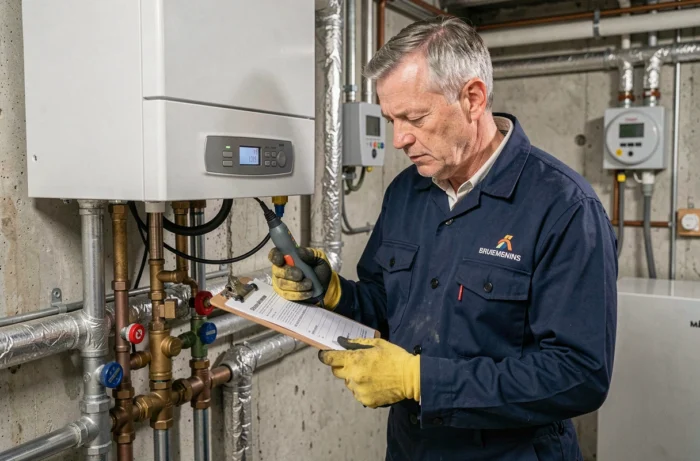
A lesser-known phenomenon complicates the situation: humidity. A damp wall conducts heat much more effectively than a dry wall. In Brussels ground floors, capillary rise degrades the insulation at the bottom of the walls and creates a persistent feeling of cold.
Changing the boiler in this context is like filling a bathtub with the drain open. The device compensates for losses by consuming more energy, without improving comfort. Insulating the walls and replacing the glazing reduces the heat demand and allows the boiler to operate within its optimal efficiency range.
Sludge and circuit fouling: an invisible problem
You have bled your radiators, checked the pressure, and yet some remain cold at the bottom. The culprit may be a buildup of sludge accumulated in the pipes.
Old heating circuits accumulate residues of corrosion, scale, and microorganisms. This sludge settles in the lower parts of the radiators and in the bends of the circuit. It reduces water flow and creates dead zones where heat no longer passes.
How to identify a fouled circuit
Touch your radiators when the heating is on. If the top is hot and the bottom is cold (after a proper bleed), sludge is likely the cause. The water that comes out during the bleed can also be an indicator: black water or water loaded with particles confirms fouling.
The treatment is called desludging. A professional connects a pump to the circuit to circulate a cleaning product, then rinses the whole system. The operation takes a few hours and restores the circuit’s thermal transfer capacity.
Installing a new boiler on a fouled circuit is a common mistake. The sludge can damage the heat exchanger of the new device and reduce its lifespan.
EPBD Directive and the future of heating in Brussels
The regulatory context is evolving rapidly. The recast European EPBD directive, in effect since May 28, 2024, provides for a gradual reduction of fossil fuel boilers. Member States must transpose it by May 29, 2026.
For Brussels homeowners, this means that investments in heating must anticipate this transition. Heat pumps benefit from a reduced VAT rate of 6% in Belgium since January 1, 2026, with an extension announced until December 31, 2030.
Before reinvesting in a heating system, the priority remains to address the causes described above. A well-balanced installation and a properly insulated building reduce the required power, regardless of the type of generator chosen. First resolve the circuit and the building envelope, then size the right device: this is the order in which comfort returns sustainably.