
Between cabin baggage and checked luggage, labeling requirements differ on several points: format, displayed information, support durability. Comparing these criteria before printing helps avoid a torn label during automated sorting or a cabin bag being rejected due to unreadable identification.
Cabin baggage label and checked baggage label: table of technical differences
Checked baggage sorting systems subject the label to mechanical constraints absent in the cabin. The table below details the concrete differences between the two uses.
| Criterion | Cabin baggage | Checked baggage |
|---|---|---|
| Recommended format | Business card (approximately 85 x 54 mm) | Elongated rectangle, visible on the handle or strap |
| Attachment | Plastic pouch, flexible tag holder | Rigid attachment, strap loop, or reinforced adhesive pouch |
| Required durability | Low (manual handling only) | High (conveyor belts, automated sorting, weather on the tarmac) |
| Minimum information | First name, last name, phone number | First name, last name, phone number, destination address, flight number |
| Recommended paper weight | Standard paper sufficient | Dense paper or lamination recommended |
The key point: a checked baggage label must withstand the friction of automated sorting, whereas a cabin label only endures your own handling. Using the same thin model for both uses exposes the checked baggage to a loss of identification during transit.
Preparing a printable luggage tag template suitable for each type of baggage remains the most reliable method to cover these two scenarios with a single PDF file.
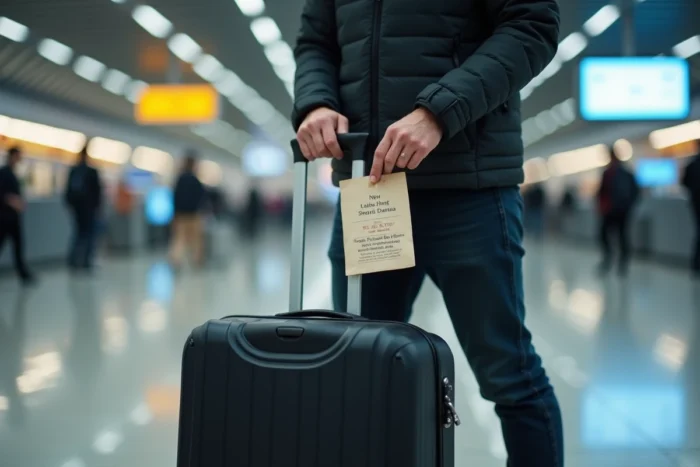
Removing old labels: a neglected step that confuses automated sorting
Experienced travelers emphasize a step rarely detailed in labeling guides: systematically removing old barcodes and labels before each new flight. Airport sorting systems scan barcodes to direct baggage to the correct carousel or connection.
An old barcode that is still readable can cause a misdirection. The baggage may then head to a previous destination or end up in an unidentified baggage circuit.
- Peel off all adhesive labels from previous flights, including partial fragments stuck under the handle
- Remove straps and tag holders displaying old flight numbers or addresses
- Check exterior pockets: some airlines slip priority or connection tags there that remain from one trip to the next
This cleaning takes less than a minute. It reduces the risk of your suitcase being directed by a scanner to the wrong conveyor, especially in large hubs where the volume of baggage processed per hour is massive.
Information to print on the luggage tag: what is truly useful in case of loss
Label templates often offer about ten fields to fill out. Not all are useful. The mobile phone number remains the most effective information for a quick return, as it allows immediate contact, even abroad.
Priority fields
First name and last name, exactly as they appear on the boarding pass. A discrepancy between the name on the label and that on the ticket complicates the claim process with the airline.
The flight number for the day and the destination address (hotel or accommodation) allow the baggage service to know where to redirect the suitcase if it arrives late. In contrast, providing your permanent postal address has limited value: no one will return baggage by mail from a foreign airport.
What is better not to display
Some travelers write their full home address on a visible tag. Displaying your personal address on baggage exposes you to security risks during your absence from home. Opt for a tag with an opaque flap or slip the contact details into a closed pouch.

GPS tracker and printed label: two complementary devices for traceability
Recent industry data shows that adding a geolocation tracker significantly reduces the time it takes to recover lost baggage. The tracker locates the suitcase in real-time, but it does not replace the physical label.
The baggage service at an airport works with the information visible on the baggage: name, flight number, contact details. Without a readable label, the tracker tells you where your suitcase is, but ground staff cannot easily return it to you without identification.
Conversely, a label alone does not tell you where your baggage is if the airline does not update the tracking. The two devices each cover a gap in the other.
- The Bluetooth or GPS tracker works even if the label is torn off during sorting
- The printed label allows ground staff to identify the owner without an app or connection
- Photographing the label and the baggage tracking number before check-in serves as useful proof in case of a claim, a point that the ongoing revision of European passenger protection rules tends to formalize
The combination of both approaches covers the most common scenario: delayed baggage, identifiable by both the digital system and the physical label attached to the handle.
Since early 2026, several airlines are tightening their controls on the compliance of cabin baggage, including checking for the presence of a readable label with contact details. Preparing your luggage tag before arriving at the airport avoids wasting time at the counter and limits the rejection of poorly identified baggage.