Creative and playful activities hold a unique place in a child’s development. They engage motor skills, language, imagination, and problem-solving abilities. Their diversity raises a concrete question for parents: among the plethora of options (workshops, free play, crafts, digital tools), which ones truly stimulate curiosity, and through what mechanisms?
Creative digital games and curiosity: what recent studies show
Most parental resources oppose screens and hands-on activities. Recent studies nuance this perspective. Research published in 2025 and 2026 indicates that certain digital games, when they offer a high degree of creative freedom (world-building, customization, solving open-ended challenges), stimulate creativity, critical thinking, and autonomy in children.
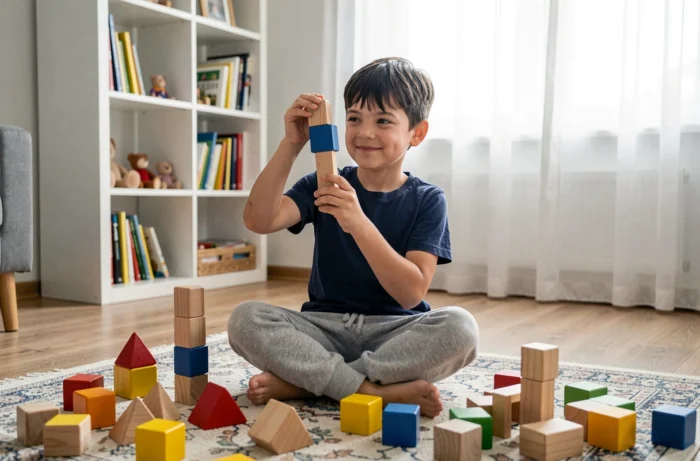
The determining factor is not the time spent in front of a screen, but the type of usage. A virtual construction game with immediate feedback, progressive challenges, and online cooperation engages working memory, attention, and organization. In contrast, passive video watching does not produce the same effects.
Recent clinical and neurodevelopmental syntheses emphasize a specific point: the impact of screens depends on age, type of activity, and the presence of an adult, more than on the simple duration of exposure. A child building a world alongside a parent who questions their choices is not in the same cognitive position as a child left alone in front of a cartoon.
This distinction is still rarely highlighted in traditional parenting guides, which often limit themselves to setting a time quota. The available data do not yet allow for conclusions on precise thresholds by age group, but the trend is clear: it is the quality of interaction that matters most.
To explore proposals that combine hands-on manipulation and active discovery, the activities on the Tout Mon Monde website offer a catalog focused on sensory awakening and creativity for young children.
Craft workshops and free expression: the learning mechanisms at play
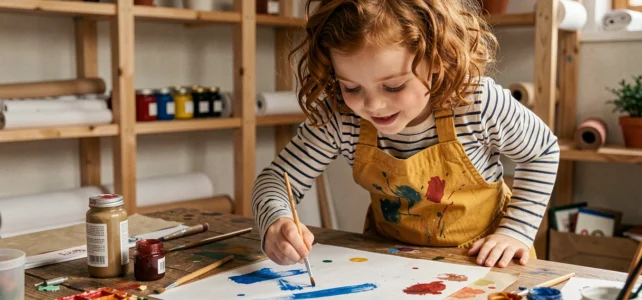
Hands-on activities (crafts, painting, modeling, collage) are not just a pastime. They simultaneously engage several cognitive functions. Manipulating dough, cutting, and assembling materials stimulate fine motor skills, planning, and decision-making.
What distinguishes a truly stimulating workshop from a simple guided coloring session is the degree of freedom given to the child in their choices. When a child decides on colors, shapes, or the order of steps themselves, they enter a problem-solving process. They test, fail, and adjust. This trial-and-error loop is a direct driver of curiosity.
What makes a creative workshop effective
- The absence of a single model to reproduce: offering a theme (an animal, a house, an emotion) without imposing an expected visual outcome encourages the child to explore their own solutions.
- The diversity of materials: mixing textures, supports, and tools (fabric, cardboard, natural elements, paint) broadens the sensory exploration field and encourages the child to make unexpected associations.
- Unconstrained time: a child who knows they have time to experiment takes more creative risks than a child rushed to finish.
Free expression workshops (spontaneous drawing, inventing stories from images, creating small performances) operate on the same principle. They place the child in the role of author, not just executor.
Outdoor activities and sensory exploration: an underestimated lever for development
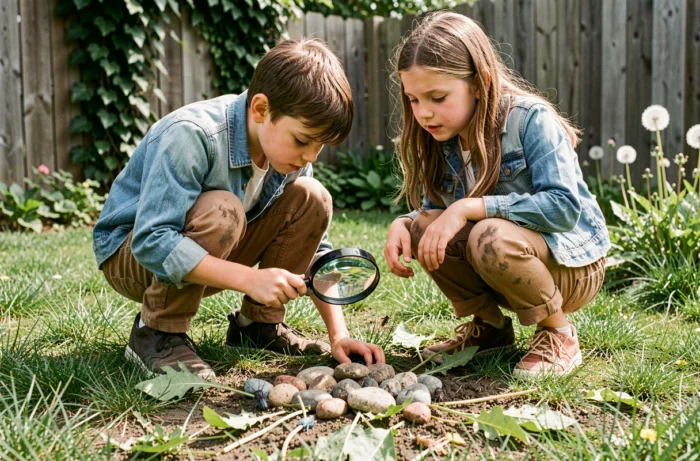
Exploring the natural world remains one of the most powerful levers for awakening curiosity. Collecting pebbles, observing insects, feeling wet soil, listening to birds: these experiences engage all the senses and generate spontaneous questions.
Outdoor sensory activities activate curiosity in a non-directed way. The child does not follow a directive; they react to what they perceive. This form of learning, sometimes called free play in a natural environment, develops autonomy and confidence.
Some concrete ideas work particularly well:
- Thematic treasure hunts (finding five leaves of different shapes, spotting three types of insects) structure observation without constraining it.
- Land art workshops, where the child creates an ephemeral composition with natural elements, combine creativity, patience, and aesthetic sensitivity.
- Gardening, even on a balcony with a few pots, allows for following a complete cycle (sowing, growth, harvest) and introducing biology concepts in a concrete way.
In contrast, highly structured outings where the child follows a path without the possibility to stop or deviate produce less cognitive engagement. The freedom to explore at their own pace remains the key factor, whether in a forest, a park, or a garden.
Emotions and imagination: the role of role-playing games and storytelling in awakening
Role-playing games (playing shopkeeper, doctor, inventing a universe with figurines) constitute a learning ground often reduced to mere entertainment. They allow the child to confront emotions, social relationships, and storytelling.
When a child invents a scenario, they structure a narrative: they set a context, introduce a problem, seek a resolution. This process engages language, emotion management, and the ability to empathize with others. Field reports vary on the optimal age to introduce elaborate role-playing games, but most children begin to engage in them spontaneously around three years old.
Shared storytelling (reading a story and then extending it together, inventing the sequel, changing the ending) operates on a similar principle. The child transitions from being a receiver to a co-creator. It is not about correcting their inventions but welcoming them and asking open-ended questions: what would this character do next, why are they scared, how could they solve this problem?
Curiosity is not decreed; it thrives in an environment that allows exploration, error, and surprise. Whether discussing a painting workshop, a guided digital game, or a walk in the woods, the common thread remains the same: allowing the child to ask their own questions before providing them with ready-made answers.