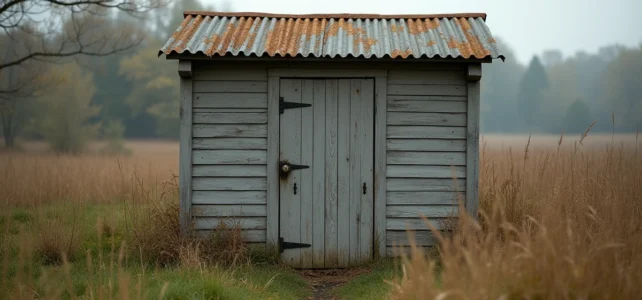
A plot classified as non-buildable by the local urban planning plan (PLU) does not prohibit all forms of installation. Placing a shed on such a parcel remains possible, but under specific conditions that vary according to the surface area, the nature of the construction, and local urban planning rules.
Development tax and removable shed: the unknown tax trap
Most owners believe that a small removable shed escapes any taxation. The reasoning seems logical: no foundations, no connections, therefore no tax.
The reality is different. The development tax applies as soon as the shelter creates a closed and covered area exceeding 5 m² with a ceiling height of at least 1.80 m, including for a removable structure. This tax is collected by the municipality and the department at the time of issuing the urban planning permit.
Structures of less than 5 m² are exempt, which explains the proliferation of micro-sheds on leisure plots. Beyond that, even a garden shed sold as “without formalities” can generate a tax bill. To better understand the rules for a shed on Public Immo, the details of the cadastral and regulatory obligations deserve careful reading before any material purchase.
Surface thresholds and urban planning permits on non-buildable land
The urban planning code distinguishes three levels according to the ground footprint of the shed. Each level triggers a different administrative procedure.
- Below 5 m² of ground footprint, no prior declaration is required, unless the land is located in a protected area (classified site, surroundings of a historical monument, natural park).
- Between 5 m² and 20 m², a prior declaration of works must be submitted to the town hall. This is the most common case for a garden shed or storage shelter.
- Beyond 20 m², a building permit is mandatory. On non-buildable land, obtaining this permit is an exception.
The fact that the land is non-buildable does not eliminate these obligations. It complicates them. The town hall can refuse the prior declaration if the PLU prohibits any construction in the concerned area, even for a shelter of less than 20 m².
The role of zoning in the PLU
A non-buildable plot is generally classified as zone A (agricultural) or zone N (natural and forested). Each of these zones has its own regulations.
In zone N, small annexes are sometimes tolerated if they are related to the maintenance of the land. In zone A, only constructions necessary for agricultural exploitation are generally authorized. A shed intended for storing gardening tools does not fall under agricultural exploitation according to the urban planning code.
The zone regulation always takes precedence over the size of the construction. A shelter of 8 m² compliant with national thresholds can be refused if the zone regulation explicitly prohibits it.
Local exceptions in risk zones: unsuspected leeway
Some PLUs provide for specific exceptions, even in areas exposed to natural hazards. The municipality of Drap, for example, allows in its urban planning regulations annexes such as garden sheds or technical rooms up to 15 m² of ground footprint in areas with a high risk of natural hazards (flooding, landslides).
This type of provision remains rare and highly regulated. It only concerns lightweight structures, without residential use, and subject to technical prescriptions (elevations, resistant materials, absence of basements).
Consulting the zone regulation of the PLU of one’s municipality before any project is the only way to know if such an exception exists. The document is accessible at the town hall or on the urban planning geoportal.
Shed on non-buildable land: risks in case of infringement
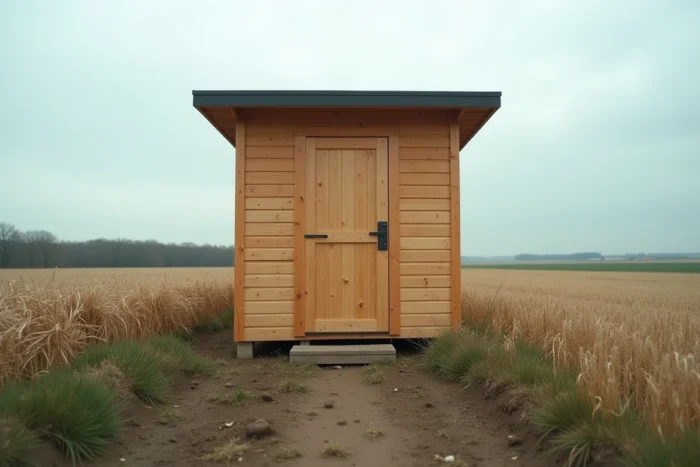
Installing a shed without authorization on non-buildable land exposes one to graduated sanctions. The urban planning department of the town hall can draw up a report of infringement, which is forwarded to the public prosecutor.
Demolition and restoration
The court can order the demolition of the construction and the restoration of the land at the owner’s expense. The statute of limitations for criminal action is six years from the completion of the work. The civil statute of limitations is ten years.
In practice, inspections are often triggered by a neighborhood report or a cadastral survey. Illegal urbanization on non-buildable plots is subject to increased monitoring in certain municipalities, especially those facing recurring issues with illegal constructions.
Regularization: a rarely possible outcome
Regularizing a shed placed without authorization requires that the construction complies with the current urban planning regulations. On non-buildable land, this compliance is exceptional. Regularization is not a right but an administrative tolerance that depends on zoning, the size of the shelter, and the absence of environmental nuisance.
Submitting a prior declaration retroactively remains possible, but the town hall has no obligation to accept it. A refusal opens the way to a demolition procedure.
The only reliable approach is to check the zoning in the PLU, consult the urban planning department of the town hall about the applicable rules for the plot, and submit the authorization request before laying the first board. A well-sized shed, declared according to the rules and compliant with local zoning, has every chance of being accepted, even on a plot classified as non-buildable.